About Me
- Camera Trap Codger
- Native Californian, biologist, wildlife conservation consultant, retired Smithsonian scientist, father of two daughters, grandfather of four. INTJ. Believes nature is infinitely more interesting than shopping malls. Born 100 years too late.
Wednesday, January 8, 2014
A Hollow Log
I've been scoping out the woods for hollow logs, meaning potential den sites, and the "jonah log" was an irresistible camera trap location.
I wasn't optimistic, because even the light from an infrared LED could dissuade an napper.
On the other hand, Craig and I had a gray fox take a high noon siesta in a cave where the white flash pulsed continuously, and it wasn't bothered in the least.
As you will see (and yes, I expect you to read this BEFORE looking at the video) no one took a nap.
But even so, there was a interesting selection of visitors.


Wednesday, January 1, 2014
Bath Party
"Damnit, some lowlife took a bath and poisoned the waterhole".
That was my first disturbing thought when I saw the white scum on the water.
It didn't smell like Irish Spring, either. But what was it?
I was visited by ominous thoughts until I got home and uploaded the video files.
Then I saw the culprits.
My pool had been the scene of a wild bath party.
Happy New Year, my friends.
Friday, December 13, 2013
Fred in a Jonah log

T'is the season to hunt for nest holes and dens, and today we found a doozy.
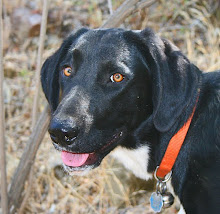
Fred, who stands 24" at the shoulder gives you an idea of this Jonah log's capacity.
I don't think it could accommodate even a puny yearling bear, but gray fox and bobcat would find it commodious.

I'm optimistic. No spider webs, and the bedding is compacted.
We'll find out.
I took the picture from an opening on the top, but I don't think the extra opening should detract from its suitability as a den.
A back door is an asset when there are unwanted guests at the front door.
And as you can see, there's more resting space beyond the second opening.

(Thanks to neighbor Bea for the photo of me scoping it out.)
Sunday, December 8, 2013
Mystery of the Night Flies
When I finally figured out that fast flying bats were causing blank video clips, I started to pay more attention to the insects in my videos.
Soon I noticed that swarms of small flies often showed up when an animal passed the camera.
I wondered if the hungry swarms ever give the critters any peace.
On the other hand, maybe the swarms aren't parasitic insects.
Maybe animals just stir resting flies into motion when they walk by.
I compiled some clips to show you what I mean.
And since I couldn't make any sense of it, I wrote to entomologist Bunyipco (an old friend) for an answer.
He didn't have an answer, and responded as expected of a taxonomist -- "Catch some specimens for identification".
"And how do I do that, may I ask?"
"Simple, hang some fly paper where you see the swarms".
If I post any pictures of bears donning fly paper next year, you'll know what happened.
Wednesday, November 20, 2013
Shop work
 |
| Neighbor Richard, Abhi Mandela and Rod Jackson at work in the garage |
Rod Jackson, CEO of the Snow Leopard Conservancy and Abhi Mandela, a firmware engineer from Silicon Valley dropped by last weekend to use the shop and talk camera traps.
 Abhi's fascination with remote camera technology was nurtured as a project assistant to Dr. Andre Pittet at the Indian Institute of Science (IISC), Bangalore.
Now he is helping Rod design an "electronic scarecrow" for snow leopard conservation.
Livestock -- from goats to yaks -- are easy prey for snow leopards throughout their range.
One leopard can slay a herd of goats in a single night, even when they are corralled right next to the shepherd's hut.
Biologists call such wanton predation "surplus killing".
It has survival value in the remotest parts of Asia where there are no people.
But killing livestock belonging to montane pastoralists is the easiest way for a snow leopard to earn a death sentence.
 |
| An IISC camera trap (left) and a PIR activated sound deterrent with a solar charger. |
The answer is that alpine herders can't afford to roof their drystone-walled corrals.
They live in a subsistence economy with an annual income of less than $400-$600.
So Jackson and his supporters are developing non-ethal deterrents.
Hopefully they will work as well but will be a lot less expensive than building a predator proof livestock pen.
We spent last Saturday laying out the work and drilling holes for switches and cables, and my good neighbor Richard, who can build practically anything offered his usual sage advice.
Tuesday, October 1, 2013
Wet & Thirsty Raptors
A number of raptors drink, bathe, and hunt in the same pools where the bears do their thing.
Not everyday, like Steller and scrub jays, but now and then.
I have a hunch that the birds seen here use several different pools on different creeks.
Screech owls were by far the most frequent users.
This video covers about 5 months of clips from several pools.
Tuesday, September 24, 2013
2013 Camera Trapping Workshop
 |
| Top (l to r): Mick Bondello, Lisa Close, Arvid Ekenberg, Thea Cooper, John Adragna, Antony Shadbolt; Sitting: Kolby Olson, Cindy Roessler, the Codger, Bill Wilson (photo by Mick Bondello) |
The Codger delivered the 5th camera trapping workshop in mid-July to an assemblage of eight curious naturalists.
Most were Californians, but two came from New York, and one Kiwi attended from far-away New Zealand.
This was the 5th workshop I have given at the Sierra Nevada Field Campus, and the days rolled by quickly.
The resident colony of mountain beaver continues to be a red-letter attraction, and most everyone was game to climb Deadman Scree for bushy-tailed wood rats.
To our ever-growing species list we added two new species.
 |
| The elusive yellow-bellied marmot. |
Participant John Adragna gave us an image of a montane vole on the second morning.
The class probably thought my enthusiasm overdone, but new species records energize the codger like a triple espresso.
Until now, we've only gotten long-tailed voles; so now we know the two species coexist right on campus.
 |
| Pouring through hundred of images. |
Indeed, the chipmunks paused briefly to gape at their images, but it didn't stop them from stuffing sunflower seeds.
But now I want to send you to Cindy Roessler's Dipper Ranch Blog for another view of the workshop.
It features a metaphysical trilogy on previsualizing camera trap sets.
"Set theory" is of course a topic I touch upon, but her treatment will give you a first hand perspective.
Start with "Thinking backwards, the camera", and then read "Thinking backwards, the animal". She informs me that the third and final piece is on its way.
Last but not least was the hands-on workshop for local Sierra County school kids.
It happened on the last day (after the camtrapping class dispersed) and started with Bill's slide show, which thoroughly engaged the kids -- who piped out the names of the critters.
Then it was snack time (graham crackers and milk are now passe).
While the kids stoked calories we instructed the parents on how to set the cameras on stumps around camp.
When kids and parents had set their cameras we sent them all off to play in the Yuba River.
By now (5 days into the bargain) Bill and I were dragging butt, but the kids were even more fired up to view the video clips.
Its nice to see such rousing enthusiasm over chipmunks.
 Finally a postscript: The class always gives me new ideas, and this time I learned the secret of finding the furtive but charismatic mountain king snake.
My teacher prefers to remain anonymous, but while walking Fred this week I put her counsel to practice.
Obviously you've got to be in the right place at the right time, but the mantra seemed to help.

Thanks guys . . .
I am grateful to "alumni" Ken, Jake, Sean, and Bill who set cameras in our old camtrapping haunts in June in preparation for the workshop.
RandomTruth's camera magic, from that log set he made in June will inspire you. Be sure to check it out.
And many thanks to Bill who stayed on to assist the full week, which was a great help.
Subscribe to:
Posts (Atom)