Thursday, December 3, 2009

Kit fox memories of Harold Egoscue


Huzzah!

We camera trapped our first kit fox (Vulpes macrotis).

It happened at 3:12 in the morning, one day after the first coyote's passage down the gully.

The visit was brief though -- we got only one picture.

There were few burrows in the area, and resident kit foxes usually forage within 3 km of their burrows.

Little canids like kit foxes need to steer clear of bigger ones like coyotes, and the best way to do it is not to stray too far from your burrows.

If not, coyotes will render a rambling kit fox into dead meat.

Suzie, Harold Egoscue's pet coyote used to scare the bejeebers out of his captive kit foxes.

Egoscue's study of kit foxes at the Dugway Proving Grounds in Utah was the first definitive study of the species.

I was lucky to work with him at the National Zoo.


Harold Egoscue in 1984 at the age of 67.

We were hired at the same time -- he was nearing the end of his career, and I was starting mine.

The zoo's young zoologists soon realized that the soft spoken ex-Marine Basque-American mammalogist had a great deal more than a technical knowledge of mammals.

He was an all-round naturalist who had logged years of field research.

He knew a great deal of botany and was a master gardener with a special knack for espalier. He knew soils and geology, archeology, and was a student of Native American crafts. He was also a flea systematist, a gifted artist, and had remarkable penmanship.

Ask him about ringtails, and he told you about the pet one he kept for a year; then he would segue into field observations and their habitat associations in Utah.

Ask him about badgers or long-tail weasels, and he had more personal experiences.

His accounts were glimpses into the past, with curious twists, often laced with Native American lore.

It was like listening to Ernest Thompson Seton.

None of us was happy when he announced that he was going to retire.

I wasn't willing to let our relationship end there.

So a couple years later, on our annual pilgrimage to the national parks we made our way to his retirement home in Grantsville, Utah.

In two fine days I learned why Harold became a naturalist.

He grew up pretty much in the middle of nowhere.

At the age of 16 his father, Jean Peter immigrated from France, and from Ellis Island went directly to Winnemucca, Nevada where Basque friends of the family set him up with a wagon and collies tending sheep.

If you haven't seen a Basque sheepherders camp, let me just say it is a pretty basic form of living -- or at least it used to be.

As was common at the time, he requested payment in sheep rather than greenback dollars, and he grazed his own animals with the company's stock.

In due course he became his own sheepman and a landowner, and married Laura Luce, a schoolteacher in eastern Oregon.

Harold was the first of 4 children.

He and his brother Peter spent summers with their father tending sheep, exploring,  observing and sketching wildlife, and collecting arrowheads.

"I would fill a 2 pound coffee can with arrow heads during the summer, and I traded and gave them all away by the time school let out the next year. Then I'd fill another coffee can."

Harold was 9 years old when his father died, and his mother took over the management of the ranches.

Without a father he gravitated to the Sue family, descendents of Chief Winnemucca.

His peer, Owen Sue taught him how to kill Townsend ground squirrels with slingshot and bow and arrow, but Harold found that he could earn more money by drowning squirrels out of their burrows with irrigation water.

"We sold them to the Indian families for 25 cents a piece.

"The women would roll the whole squirrel in clayey mud and toss it in the fire, which was an open hearth on the middle of the house.

"In 15 minutes the squirrel was cooked.

"The hair and skin came off with the clay, and they flicked the viscera into the fire. Then it was ready to eat.

Harold was proof that you can learn a lot in the middle of nowhere.

After 4 years in the Marines, and a bachelors degree at the Utah State University he returned to the basin and range country.

His education about things natural was self driven.

I only wish he was still around.

I still have a lot of questions for him.

Harold's publications on Kit Fox 

Egoscue, H.J. 1956. Preliminary studies of the kit fox in Utah. Journal of Mammalogy, 37:351-357

Egoscue, H.J. 1962. Ecology and life history of the kit fox in Tooele County, Utah. Ecology, 43(3):481-497

Egoscue, H.J. 1966. Description of a newborn kit fox. The Southwestern Naturalist, 11(4):501-502

Egoscue, H.J. 1975. Population dynamics of the kit fox in western Utah. Bulletin of the Southern California Academy of Sciences, 74(3):122-127

He also wrote the Mammalian Species (American Society of Mammalogists) account of the Swift Fox based on a review of the literature:

Egoscue, H.J. 1979. Vulpes velox. Mammalian Species, No 122:1-5.

Sunday, November 29, 2009

Irresistable can in the ditch


Once you punch a few holes in the can, the aging process begins.

After a few warm days the mackerel becomes an even more powerful attraction to carnivores.

The first yodel dog (above) appeared 5 days after Craig staked the can, and there were 8 more visits over the next 23 days.


A pair of coyotes, perhaps the residents, passed by without approaching the sample closely.


The others were apparently singletons/transients who sniffed deeply of the brewing fish,


and scratched at the soil.


And at least one clever coyote tried to lift the can off of the rebar stake.

There's no telling how many different yotes we photographed, but it is clear that the gully is used by more than the pair.

Friday, November 27, 2009

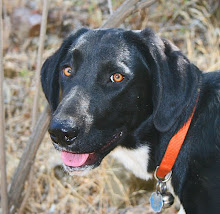
Fred's First Birthday


We celebrated Fred's birthday the day before Thanksgiving.

The g'kids made him a hat, which he tolerated for the photo op.

Then we lit a candle in his dog food and sang Happy Birthday.

The only thing he enjoyed was the dog food -- a junk food treat rather than his usual dried chow.

Wednesday, November 25, 2009

Burrowing owl at the badger dig


On November 1st at 6:43 AM the burrowing owl made its only appearance -- ten days after we set the camera.

It immediately crept down into the burrow entrance where the camera captured images of its speckled interscapular and wing feathers.


Perhaps this assured the bird that nothing predacious was lurking below, because it spent the next 10 minutes above ground posing for pictures.


In my undergrad years I  was quite taken with burrowing owls.

Their table scraps -- pellets, kangaroo rat legs,  and rodent skulls -- decorated the dashboard of my car,  mementos of good trips to the charming desolation of San Benito County.


According to Hans Peeter's book, Field Guide to Owls of California and the West (UC Press) burrowing owls decorate their nests and burrow entrances with chunks of cow flops and road apples.

Another endearing trait.

We'll be on the lookout for breeding burrowing owls in the spring.


Tuesday, November 24, 2009

Brawl at the badger dig


Set 305: a badger dig in the grassland.


There are several possibilities of course, but when you set a cam at a badger dig you are hoping for a badger.

Badger diggings are common in grassland at Chimineas, because California ground squirrels are abundant.

Set 305 was a ground squirrel burrow that seemed to have been enlarged by a badger.

Craig notes that big clods of dirt indicate that the digger is a badger, rather than a ground squirrel, whose excavation equipment is much smaller.

So we staked a camera next to the burrow, and knowing that diurnal ground squirrels could fill a card in a few days, we set it for night pictures only.

As we viewed the pictures last week, it was apparent that mice outnumbered badgers.

In fact there were no badgers, and less than one out of 3 pictures had an animal in it.

California pocket mice (Chaetodipus californicus) were the most common visitors, and had no doubt caused the false triggers.


Most of the pictures were presumably of one mouse puttering around the burrow tailings and entrance.

One expects small mice to live in small burrows, so my assumption is that this one lived nearby and was foraging for seeds in the exposed soil of the ground squirrel nest.

But it could have had a sub-burrow somewhere within the ground squirrel tunnel.

A few frames later revealed that an intruder had brazenly entered the resident's territory.

For its cheekiness it was paying the price.


The brawlers were locked in mortal combat.


They broke apart and faced off.

At that point the resident retreated to the burrow, and it seemed to be over.


But a few moments later they were at it again, this time boxing.


In the final frame the apparent winner watched the vanquished preparing to retreat into the forest of grass.

The brawl had lasted a little more than a minute.


Victory is sweet.

Sunday, November 22, 2009

Chimineas in November

View from set 319


Just back last night from the Chimineas Ranch, and at the moment am downloading the latest photos.


View from set 318


An excellent though brief trip.

We were joined by Randomtruth, and talked camera trapping and wildlife practically nonstop.

RT also brought a camera trappers toy -- a plumber's cam, which we used to peer down a few burrows.

The LED encountered something you don't often find in pipes and drains -- dust.


Scoping a burrow with the plumber's cam.

And thus we found another project, how to make the plumber's cam more burrow-friendly.

On finding that a few cameras filled their memory cards with false triggers ... well, we sang the camera trapper's blues.

Nonetheless we got some interesting photos and added another species to the list, which you'll see in a few days, if not sooner.

At the end of two full days we managed to set 12 cams, with four more to go this week when Craig returns to the ranch.

And oh yes, Fred proved that he has a powerful nose for antlers, even if they are hanging on a wall and attached to a skull.


Many thanks to RT for help and good company, and to Kim and the Redhead for cooking the apple/berry pie and beef stew. We ate well!

Thursday, November 19, 2009

Leaping coyote


Camera traps occasionally get pictures of coyotes in flight, but usually not like this.