 |
| A chickaree aka Douglas squirrel came first. |
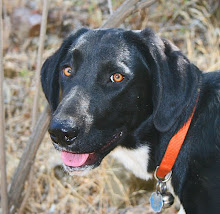
Well, Jake volunteered to join me, so I didn't have to climb Deadman alone.
 Normally Fred would have been there too, but the redhead took him home so I could wrap up the workshop and pack up without distractions.
The cameras had been out for only 48 hours and memory should have led me to them like a bird dog, but even with the GPS we bumbled about looking for the first set.
Of course we checked the pictures as soon as we found it -- the moment of truth had arrived.
The first visitor to the set, a runty chickaree and doubtless young of the year, left one picture the morning after we set the camera.
We clicked forward . . . blank images . . . and hallelujah!
There was bushy-tail poised on a rock and showing its diagnostically furry bicolored caudal appendage.
It had visited the second night and like the chickaree had left but one photo.
We resumed our climb to the top of the scree and found the second camera just before noon.
A pinon mouse had visited the first night.
And Little Chief Hare made a cameo appearance the next day.

Deadman had paid off, and we ate lunch with satisfaction beside the set.
Our mountaineering exercise had proved that habitat is often key to finding one's target species.
Both pika and bushy-tailed wood rat evolved in the footprints of glaciers.
For two years I had sought the wood rat among boulders and outcrops only a half mile from here.
It should have been there, but only after ploughing the literature did I learn that talus was also one of bushy-tail's favored habitats.

We explored the rest of the scree into early afternoon, and recorded waypoints for a big red fir, and a new colony of mountain beaver.
Then we drove back to camp to show off the pictures.
 Normally Fred would have been there too, but the redhead took him home so I could wrap up the workshop and pack up without distractions.
The cameras had been out for only 48 hours and memory should have led me to them like a bird dog, but even with the GPS we bumbled about looking for the first set.
Of course we checked the pictures as soon as we found it -- the moment of truth had arrived.
The first visitor to the set, a runty chickaree and doubtless young of the year, left one picture the morning after we set the camera.
We clicked forward . . . blank images . . . and hallelujah!
There was bushy-tail poised on a rock and showing its diagnostically furry bicolored caudal appendage.
 |
| The bushy-tailed wood rat (Neotoma cinerea). |
It had visited the second night and like the chickaree had left but one photo.
We resumed our climb to the top of the scree and found the second camera just before noon.
A pinon mouse had visited the first night.
 |
| Judging from those big ears it was a Pinon mouse (Peromyscus truei) |
And Little Chief Hare made a cameo appearance the next day.

Deadman had paid off, and we ate lunch with satisfaction beside the set.
Our mountaineering exercise had proved that habitat is often key to finding one's target species.
Both pika and bushy-tailed wood rat evolved in the footprints of glaciers.
For two years I had sought the wood rat among boulders and outcrops only a half mile from here.
It should have been there, but only after ploughing the literature did I learn that talus was also one of bushy-tail's favored habitats.
 |
| Our routes in and around Deadman Scree. |

We explored the rest of the scree into early afternoon, and recorded waypoints for a big red fir, and a new colony of mountain beaver.
Then we drove back to camp to show off the pictures.


