About Me

My photo
Native Californian, biologist, wildlife conservation consultant, retired Smithsonian scientist, father of two daughters, grandfather of four. INTJ. Believes nature is infinitely more interesting than shopping malls. Born 100 years too late.
Showing posts with label Heermann's kangaroo rat. Show all posts

Friday, January 21, 2011

Saltos Canyon


Saltos Canyon may have its waterfalls in January, but most of the year it's a dry canyon with a few seeps and stagnant pools.

In late September we searched the lower reaches of the canyon for water where we might place some cameras.

The only water we found were a few small pools, and yellow jackets lined the seeps like drunks in a bar.


The potability of the water is another question.

It leaves a rime when it evaporates, possibly a derivative of gypsum which is abundant there.

But few vertebrates can live without water so we continued our search for a suitable place to set a camera.


After a mile and a half the canyon opened up, and we found a pool pocked with hoof prints.

We set a cam there in the shade of the mule fat.

We returned a month later. 


Wood rats, Peromyscus, and a Heermann's kangaroo rat visited the puddles.

Though kangaroo rats and pocket mice can live on metabolic water from their food, a photo of a drinking k-rat would have been a prize.  

Black-tailed deer and cottontails also showed, but they weren't regulars.


Bobcats were more frequent visitors.

Two of them, though not together, were often snapped in a swarm of moths. 

So the bats were there too. 


Thursday, October 28, 2010

Rodent rendezvous

The large burrow at the mouth of Badger Head Gulch


The mouth of Badger Head Gulch was a broad dry-wash with a sandstone bank, and in that bank we found a burrow large enough to be a carnivore den.


Since Fred kept coming back to sniff the burrow, it became camera trap set 393.


The camera snapped 155 pictures during the next 42 days of August and September, and the site was bustling with rodent activity.

Four species.

I am not sure what the attraction of the site was to these rodents, but not a single carnivore made an appearance.


Heermann's kangaroos rats were the most common visitors.

Adult Heermann's kangaroo rat (Dipodomys heermanni)

Some of them were juveniles.

Juvenile k-rat before filling the external check pouches

You can tell them from adults by their fetching, sleek, big-eyed looks. Very cute.

after filling the cheek pouches

The California pocket mouse was the other heteromyid rodent that visited the site, and though it is widespread at Chinineas, it was infrequently seen at this site.


The California pocket mouse (Chaetodipus californicus)

Thursday, July 15, 2010

The log botherers


The camera at set 340 managed to take 100 images before the mysterious impostor filched the batteries 3 weeks into the venture.

But let's forget the impostor and talk about the others who visited our set.

A handsome Heermann's kangaroo rat was an active visitor.


It even ventured into the log.


Of course there were deer mice,


 and a fit looking cottontail also explored the inner architecture,


which just proves something we already knew -- fallen logs are attractive features to small mammals.

But in addition to the log's natural allure, some bumbling biologists had stuffed a perforated can of cat food down a ground squirrel burrow right behind that grass.

This might have attracted a bobcat with nicked ears,


that waited patiently for that smelly can or a small mammal to appear.


A few days later our old friend with the crumpled ear showed up with those jade cat eyes.


He's a poker-faced veteran of the range. 

And we know he's an old rambler, because this is two miles from the hilltop where we clicked him last fall. 

With a range that large the chances are good that this cat is a male. 

Wednesday, September 16, 2009

Last camera trap, last hope for ringtail


The recess -- a predators lair with cattle bones.


Three of the four camera traps we had set at Chimineas had no sign of ringtail.

I've talked about two of the sets already, and I won't bore you with the deermice and woodrats that visited the third set -- a low hillside of weathered boulders.

Of more interest was the secret petroglyph, but like the ringtail, it couldn't be found. 

Our fading hope was the final location -- a v-shaped outcrop with a horizontal recess.  

It was near a dry wash at the convergence of several routes including a dirt road and something had dragged cattle and deer bones into the recess. 

Topographically it was one of those places that makes you want to climb around and explore. 

Two months ago we decided the recess was the place to set the camera. 

The problem had been anchoring the mounting post between the floor and ceiling.

I had jammed it here and there with a vague sense of self-loathing for failing to make an expandable post required by this situation. 

After wedging some rocks under the post I was satisfied it would hold as long as nothing bumped into it.

So here we were two months later.

We looked into the recess and . . .  "Noooo, tell me its not true" --  the camera was lying face down on the bedrock. 

That might not be a bad thing.

We opened the cam and looked at the pictures -- there were 138 of them taken over five days.

Not bad.

As you might have guessed ringtail was missing, but . . . .
.
.


there were several pictures of a ringtail imitator.

A wood rat had chimney-stemmed the crevice at the back of the recess. 

A male bobcat had also visited to explore the scents we had planted. 

He didn't show his face, but he made a departing gesture 11 seconds after this photo.


He sprayed urine on the left side of the wall. 


A fence lizard passed through, and one morning Lincoln's sparrow scratched about. 


Correct my id if I am wrong.   


One evening a kangaroo rat (probably Dipodomys heermanni) showed up. 

A nice surprise.

A wood rat in the background and a kangaroo rat up front. 


We weren't ready to quit this place, so we piled rocks around another camera (the one at the top of the page). 

Craig checked it last week.

There was plenty of animal sign, and maybe ringtail had been there. 

But I had set it for 24 hr pictures, a mistake.

Hot air movement triggered the camera continuously.

The card was filled with pictures of hot rocks.  


Wednesday, September 24, 2008

Pleasant surprise at the rubbing post


The camera trapper's lament is that feral pigs like to rub against posts, including the one with your camera on it.

That's what happened at the spring in North Portuguese Canyon. The camera angle changed daily, and finally it pointed at the ground.

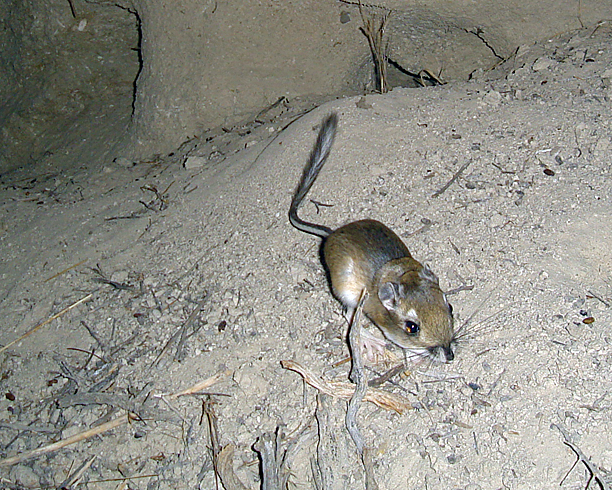
The good part is getting a picture of a kangaroo rat -- specifically the 4-toed Heermann's Kangaroo Rat. (The only other species in the vicinity is the Graceful Kangaroo Rat, which has 5-toes.

The rat came two nights in a row.

I owe it to the pigs.