About Me

My photo
Native Californian, biologist, wildlife conservation consultant, retired Smithsonian scientist, father of two daughters, grandfather of four. INTJ. Believes nature is infinitely more interesting than shopping malls. Born 100 years too late.
Showing posts with label Sierra Nevada Field Campus. Show all posts

Sunday, November 23, 2014

Little Earthmover


Ever wonder what a mountain beaver does outside of its burrow?

No?

I guess I'm not surprised. 

Well, have a look anyway.

Here's some footage of a mother and her offspring taken during last summer's Camera Trapping Workshop in the northern Sierra Nevada.

There's not much to say.

Mountain beavers are just like big pocket gophers when it comes to moving earth. 

Tuesday, September 24, 2013

2013 Camera Trapping Workshop

Top (l to r): Mick Bondello, Lisa Close, Arvid Ekenberg, Thea Cooper, John Adragna, Antony Shadbolt;
Sitting: Kolby Olson, Cindy Roessler, the Codger, Bill Wilson (photo by Mick Bondello)


The Codger delivered the 5th camera trapping workshop in mid-July to an assemblage of eight curious naturalists.

Most were Californians, but two came from New York, and one Kiwi attended from far-away New Zealand.

This was the 5th workshop I have given at the Sierra Nevada Field Campus, and the days rolled by quickly.

The resident colony of mountain beaver continues to be a red-letter attraction, and most everyone was game to climb Deadman Scree for bushy-tailed wood rats.

To our ever-growing species list we added two new species.

The elusive yellow-bellied marmot.
Bill's trail camera snapped a yellow-bellied marmot, which is a little embarrassing because marmots are anything but rare in the Sierra Nevada.

Participant John Adragna gave us an image of a montane vole on the second morning.

The class probably thought my enthusiasm overdone, but new species records energize the codger like a triple espresso.

Until now, we've only gotten long-tailed voles; so now we know the two species coexist right on campus.

Pouring through hundred of images. 
Other highlights were a sighting of the local family of otters, and an experiment on mirror image recognition in chipmunks.

Indeed, the chipmunks paused briefly to gape at their images, but it didn't stop them from stuffing sunflower seeds.

But now I want to send you to Cindy Roessler's Dipper Ranch Blog for another view of the workshop.

It features a metaphysical trilogy on previsualizing camera trap sets.

"Set theory" is of course a topic I touch upon, but her treatment will give you a first hand perspective.

Start with "Thinking backwards, the camera", and then read "Thinking backwards, the animal". She informs me that the third and final piece is on its way.

Last but not least was the hands-on workshop for local Sierra County school kids.

It happened on the last day (after the camtrapping class dispersed) and started with Bill's slide show, which thoroughly engaged the kids  -- who piped out the names of the critters.

Then it was snack time (graham crackers and milk are now passe).

While the kids stoked calories we instructed the parents on how to set the cameras on stumps around camp.

When kids and parents had set their cameras we sent them all off to play in the Yuba River.

By now (5 days into the bargain) Bill and I were dragging butt, but the kids were even more fired up to view the video clips.

Its nice to see such rousing enthusiasm over chipmunks.

Finally a postscript: The class always gives me new ideas, and this time I learned the secret of finding the furtive but charismatic mountain king snake.

My teacher prefers to remain anonymous, but while walking Fred this week I put her counsel to practice.

Obviously you've got to be in the right place at the right time, but the mantra seemed to help.


Thanks guys . . .

I am grateful to "alumni" Ken, Jake, Sean, and Bill who set cameras in our old camtrapping haunts in June in preparation for the workshop. 

RandomTruth's camera magic, from that log set he made in June will inspire you. Be sure to check it out.

And many thanks to Bill who stayed on to assist the full week, which was a great help.
Tuesday, August 7, 2012

2012 Camera Trapping Workshop


2012 Camera trapping class:
Top row: Greg MacDonald, Hannah Stewart, Patti ten Boom Byrnes, Natalie Fenner, Timothy Fenner, Sam Dailey.
Bottom Row: Joshua Fenner, Bill Wilson, Gwen Dailey, Chris Wemmer, Doug Overman, Lance Milbrand, Caitlin Ott-Conn.  

Thunder showers and an electrical outage got us off to a slow start, but otherwise, the 4th camera trapping workshop at SF State University's Sierra Nevada Field Campus came off well.

Participants of past workshops helped the codger by setting their own cams in the Yuba country a month beforehand, and when the job was done we had a total of 15 in the field.

We were confident we'd have a few photos of Bruin. Large piles of bear scat seemed to litter one meadow where we set two cameras. 

But when we went to collect those cameras we found ourselves in the midst of a logging operation. The bears left us empty-handed.

The field campus provided ample opportunities for camera trapping, and back at camp, however, Patty ten Boom Byrnes captured video of a cub exploring a log. (Sorry I can't upload it.)


Doug Overman with his pre-Galileo
all purpose cam mount.   

Just down river from the tents Bill Wilson added a new species to our Sierra County mammal list -- an incomplete but unmistakable image of a river otter.

Bill Wilson's river otter visited a log jam below camp.

Not far away RandomTruth's cam snapped a bobcat.


Above camp Caitlin Ott-Conn got a photo of an upright showtl -- not a pose commonly caught on our cameras.


The class harvested the usual assemblage of cute rodent pictures.


We added the long-eared chipmunk to the species list -- and you can see here one of its distinguishing marks -- long almost unchipmunkly ears.

The Douglas squirrel or chickaree


Chickarees were the usual early morning and late afternoon camp visitors, but our subterranean video cam once again caught them doing mysterious things in mountain beaver burrows.
Golden mantled ground squirrel.


Golden mantled ground squirrels were already plumping up for hibernation. If the bitter cherries are any indication, there will be heavy mast crop this fall.


Jake's cam also got an image of a Wandering shrew (Sorex vagrans).  See if you can find it.


To celebrate the "strenuous life", we forded the Yuba's north fork and climbed Deadman Scree.  Everyone marveled (I hope) at this geological phenomenon and savored a habitat that cooks in the midday sun but hides an ice age climate in the underworld beneath the rubble.  

On the Deadman talus slope with Lance in video-documention mode.  

We had a couple of camera failures, but still managed to capture some portraits of bushy-tailed wood rats in various stages of development.


A heartfelt thank you to the "alumni" who helped me out on Tuesday night by making presentations about their own camera trapping discoveries.

Jake and Christian compared still pictures with video clips, their message being that if one relies entirely on still pictures one gets snapshots of a much bigger story. Video clips contain much more information. 

Random Truth presented his ideas about close-ups and serendipitous sets with gorgeous examples of woodrat activities in the coastal range and critters from the eastern Sierra.

A serendipitous mountain beaver set -- no "Aplodon,
but a handsome Western tanager (Sam Dailey's photo).

My subterranean cam yielded some chickaree and showtl footage, but a bear cub curtailed that set when it uprooted the cam and turned it on its back. (More about the challenges and risks of subterranean cam-trapping soon.)

I'll be heading back in another week or two -- as soon as I get some special mounts made for some odd sets.

Many thanks to the "alumni" from previous courses, Jake, Christian, Sean, and Random Truth, and to Bill Wilson for assisting with local logistics during the full week.

Last but not least, thanks to the class for enthusiasm and hard work.

One of a series of time lapse photos taken at lunch with a Canon A630. The camera was hacked with the Canon Hack Development Kit (CHDK). We also demonstrated motion detection.

Tuesday, August 2, 2011

Class of 2011

(left to right) JR Blair (SNFC Director), Audrey Nickles, Lissa Derugin, Bill Wilson (SNFC alumnus), Chris "Codger" Wemmer, Sebastian "Seabass" Kennerknecht, and Carl "Montana" Hansen"

The class was small, but when the goal is teaching, small is beautiful.

Monday morning started with a lecture on camera trap sets, followed by a field demonstration on making a set (i.e., selecting of a site and positioning the camera).

Seabass demonstrates his set using
a DSLR and external flashes

After that, the class made their own sets and I kibbitzed.


That afternoon we started checking the camera traps set last month.


Back in June five of last year's class joined me in setting cams for the workshop.

So instead of the 4-5 cams I usually set by myself, we had 12 cams waiting for us.

We puffed our way up a hill to a log set among red firs, and we found a long series of pine marten photos waiting for us.

My old buddy Carl suggested I'd "cooked the results".

Those two photogenic martens had posed superbly, and I did lay it on rather thick as I scoped out each successive shot.

In addition to the daily routine of exploration, and setting and checking cams, we spent the evenings re-hacking one of Carl's cameras, photographing flying squirrels at a feeder, and getting the analog-digital converter to work with my new "gopher cam".

We'll talk about the latter -- a "burrow scope" for snooping in tree cavities and underground dens -- in a future post.


Carl got the Codger's "gopher cam" working. 


Later in the week we forded the North Yuba at a log jam to explore the wonders of talus and giant red firs.

"Okay, troops, tell me the size of this tree".

Earlier in the week we had measured one with a 15 foot circumference, so again I dug the tape measure out of my pack.

This one measured in at 17 feet, and the two best guesstimates were only off by a foot. 

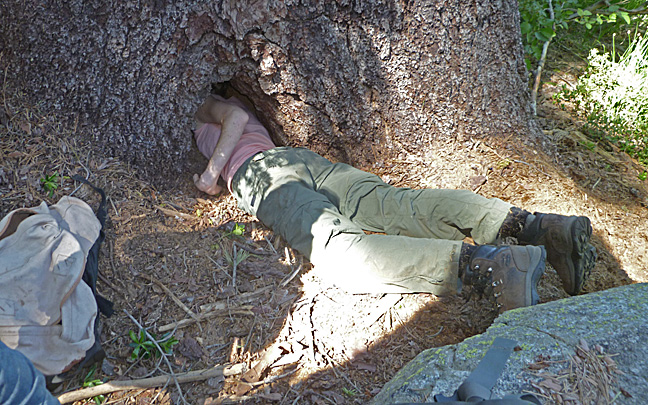
Seabass then drew our attention to a cavity on the other side of the old veteran. 


It was a respectable cavity with a vertical hollow of unknown length.

There was enough space in there for a coyote or even a few bear cubs. 


A perfect cone of frass inside announced an infestation of wood ants, but as ants go they were friendlies, 

We all agreed it was a good place to set a camera. 


The class conferred on what kind of set to make, and settled on a Jonah set (in the whale's belly).

Lissa crawled in, set the cam, and took a self portrait. 


In a few weeks we'll have a camtrappers' rendezvous to see if anything visits the hollow in the old giant, or if the showtls passed our subterranean cams.

Sunday, July 24, 2011

Sunrise showtl


Dawn chorus and showtl appears
in scattered light of frond and leaf
Through the firs sunlight breaks


As Codger followers by now realize, I am just back from a week at SF State University's Sierra Nevada Field Station, where images of showtls have moved me to feeble attempts at poetic expression. 

The class discovered their camera-trapping instructor was obsessed with the showtl, and if you don't know anything about mountain beavers, sewellels, showtls or Aplodontia rufa, read here.

And by the way, this image was the first attempt at showtl espionage by the ladies of the class.

I'd say they did pretty well. 

As I wind down and unpack, I'll be working up the images.

More on the workshop this week, and thanks to Carl for photoshopping this problematic image.

(Now I am off to the flume where I lost my glasses this afternoon.)

Wednesday, August 4, 2010

Denizens of Deadman


A chickaree aka  Douglas squirrel  came first. 

Well, Jake volunteered to join me, so I didn't have to climb Deadman alone.

Normally Fred would have been there too, but the redhead took him home so I could wrap up the workshop and pack up without distractions.

The cameras had been out for only 48 hours and memory should have led me to them like a bird dog, but even with the GPS we bumbled about looking for the first set.

Of course we checked the pictures as soon as we found it  -- the moment of truth had arrived.

The first visitor to the set, a runty chickaree and doubtless young of the year, left one picture the morning after we set the camera.

We clicked forward . . . blank images . . . and hallelujah!

There was bushy-tail poised on a rock and showing its diagnostically furry bicolored caudal appendage.


The bushy-tailed wood rat (Neotoma cinerea).

It had visited the second night and like the chickaree had left but one photo.

We resumed our climb to the top of the scree and found the second camera just before noon.

A pinon mouse had visited the first night.


Judging from those big ears  it was a Pinon mouse (Peromyscus truei)

And Little Chief Hare made a cameo appearance the next day.


Deadman had paid off, and we ate lunch with satisfaction beside the set.

Our mountaineering exercise had proved that habitat is often key to finding one's target species.

Both pika and bushy-tailed wood rat evolved in the footprints of glaciers.

For two years I had sought the wood rat among boulders and outcrops only a half mile from here.

It should have been there, but only after ploughing the literature did I learn that talus was also one of bushy-tail's favored habitats.


Our routes in and around Deadman Scree.


We explored the rest of the scree into early afternoon, and recorded waypoints for a big red fir, and a new colony of mountain beaver.

Then we drove back to camp to show off the pictures.


Sunday, August 1, 2010

The hot rocks of Deadman Scree

The hot rocks of Deadman Scree -- home of Little Chief Hare and Bushy-tailed wood rat.


I knew they'd soon be ahead of me so my parting advice was "Keep an eye out for urine stains on the rocks."

With that the class began the ascent through the red firs and hungry mossies to the hot rocks of Deadman Scree.

Actually, the adventure began with a foot bath because the Yuba River was a bit too high for rock hopping.

Footbath in the Yuba

The hikers spread out in the forest as they climbed to the scree and good-will-ambassador Fred dashed about paying visits.

I was busy photographing orchids and wintergreens.

The guy could use sun glasses.

When I finally reached the scree the troops were catching their breath half way to the top of the rock slide, but not far away was Christian, who was apparently moving at my more leisurely pace.

He seemed to be in a peaceful reverie -- perhaps meditating.

"Let's look for urine stains," said I.

We began the search for bushy-tail's pissing rocks, and in no time found them in the rubble.

Bushy-tail's white-washed pissing rocks.

This stuff was not the golden amberat (or crystallized urine) that fooled the 49ers into thinking it was peanut brittle.

It seems the stone-oven heat of the scree cures rat urine differently. The finished product is a powdery whitewash.

I coached Christian in making the set.

We notched a stick with the kukri, lashed a cross piece for the camera mount, and jammed it between the rocks.  A few taps with a stone lodged it firmly in place.

Christian with camera trap crucifix.

Then it was time for the essenses -- castoreum and civetone -- dabbed on twigs and tossed on a likely rat perch.

Finally we powered the camera, reached up into the recess and waved our hands before the camera's sensor -- it was working.

The set was ready and the uphill climb continued.

Christian was soon out of sight, while I  plodded onward and upward with frequent pauses to gulp water and study the scree.

Near the top of the rock slide I found another place that whispered -- "this is where rodents and little chief hares do their thing".

I set a second camera and GPS'd the location.

It took another half hour for Fred and me to negotiate boulders and fight our way through a thicket of huckleberry oak, and suddenly Deadman Lake and Peak were in sight.


The troops were eating their lunches and disporting themselves in the cool water of the lake.


They were in good spirits; we took pictures and they hammed for my camera.


All agreed Sean's pose was more like
Teddy Roosevelt than John Muir.
 

"Did you set any camera traps?" I asked.

"We couldn't find any sign or good places", they replied.

There was only one nut who obligated himself to climb Deadman again.

Wednesday, July 28, 2010

2010 Workshop


Top: RandomTruth, Aviva, Jake, Christian, Sean, Richard. Middle row: Theresa, JoEllen. Front Row Kneelers: Bill, the Codger
(photo by Bill Wilson)

A few words about last week's camera trapping workshop.

The venue was the Sierra Nevada Field Campus, San Francisco State's hideaway among the red firs . . . . on the North branch of the Yuba River . . . where the skies are clear, and tumbling water and pine-scented air lulls you to sleep in the starry night.

Adjusting the camera for a full frame shot. 
We started on Sunday evening with introductions, goals, and a powerpoint presentation on the history of camera trapping.

The next morning I introduced the students to "set theory" -- otherwise known as staging wildlife photos.

I wanted the class to become familiar with the strengths and limitations of their own cameras as well as the home-brews I put at their disposal.

As you know, young folk are vulnerable to cravings, and wild places like this feed that understandable craving to camera trap big charismatic animals.

Large mammals usually play hard to get with camera traps and thus spawn disappointment.

So I encouraged the class to target rodents whose squirrelly ways can be highly entertaining.

They are also more cooperative than mountain lions, bears and coyotes. 

For a few sunflower seeds on a stump countless photo ops are the reward, and by varying the camera's height, distance and angle to the "stage" the greenhorn can appreciate the photographic effects and learn about optimal camera placement.

So we started by setting cams for chipmunks, golden-mantled ground squirrels, and chickarees near camp, and the class captured them all in pixels, as well as an acrobatic long-tailed meadow mouse.

We also devoted two mornings to collecting the cams I had set in June, and I am pleased to report that aplodon generously supplied self portraits which you'll see in the next post. 

My annual fix of aplodon reassures me that some things in this state aren't going to hell in a handbag, and seeing the little buggers was a relief.

There were so few burrows back in June that I was sure the population had crashed.

We also added two new species to the list -- Nuttall's cottontail and a bobcat, not to mention a hermit thrush feeding its fledgling.

Viewing results of camera trap sets
Post-prandial powerpoint presentations treated set theory, use of attractants ("To use or not to use"), animal psychology for camera trappers, and survey methods.

To keep the class jazzed about camera trapping possibilities, I showed the work of two fellow camera trappers from Minnesota.

Sean Hall provided images from the north woods, and Chuck Gackstetter covered the prairies of SW Minnesota. (Thanks a lot, guys.)

RandomTruth sets a camera unaware of 
encroaching man-eating ferns.


Sean by the way is the maestro who orchestrates Camtrapper.com.

It's a camera trapping forum full of useful hints, advice, and inspirational pictures of wildlife and sets, and is definitely worth bookmarking.

Thanks to the class for a great week, and to RandomTruth for enthusiastic assistance and splendid photo-documentation of the botanical wonders of the northern Sierra.

I'll talk about the outings and recces next time.