About Me

My photo
Native Californian, biologist, wildlife conservation consultant, retired Smithsonian scientist, father of two daughters, grandfather of four. INTJ. Believes nature is infinitely more interesting than shopping malls. Born 100 years too late.

Thursday, March 29, 2007

Who goes there?


Ever since Richard and I equipped our garbage cans with the "screaming canaries" ($1 security alarms), I've put a camera trap by the garbage cans the night before collection. I want to photograph Sasquatch, the garbage-loving bear in action. If the alarms work, I might get one shot of her before they go off and she high-tails it down the road. If they don't work, she'll reward us with a mess of pictures and a mess of garbage. Though we expect to see her soon, Sasquatch has been enjoying winter sleep probably since late October.


In the meantime I have accumulated an inventory of garbage can passersby and visitors. The usual cast of characters includes black-tailed deer, cats, skunks, gray foxes, and jackrabbits.

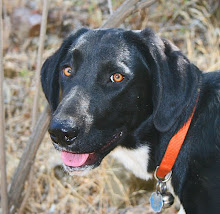
But our neighbor's dog, Jaden is the most faithful visitor. He shows up around 9:00PM to enjoy the simple pleasures of life, several deep sniffs of garbage followed by the pause that refreshes.


Wednesday, March 28, 2007

A mossy gym sock in a tree

Photo: California Academy of Sciences


Many years ago when I was in junior high school the California Academy of Sciences had a diorama of nesting bushtits. The nest was a fine work of animal architecture that looked as soft as a wool sock. The engineers were tiny bits of bird fluff perched in the nest's domed entrance and on a nearby twig.

I never failed to pay a visit to that diorama and other favorites on Saturday excursions to the academy, but I never managed to find a bushtit's nest, which is probably just as well.

The bird-nest-collecting phase of my youth ended abruptly one August day when my family returned home from summer vacation. When we entered the house our legs started to itch. The itching quickly spread upwards, and soon we were all scratching wildly. We were feeding thousands of hungry fleas.

My mother immediately concluded that my bird nest collection was the cause and unceremoniously consigned it to the garbage can. I felt it was an unfair rush to judgement. I mean, we DID have a dog and dog bedding in the house. However, if a bushtit nest had been among those discarded treasures, I might still be in therapy.

My appreciation of bushtit nests lay dormant for nearly a half century, but when we returned to California, I was thrilled again to watch these self-absorbed bits of fluff foraging in the oaks around the house.

 I knew something was up two weeks ago when on two consecutive days I encountered a pair in the vicinity of a particular canyon live oak.

 Then I discovered a "mossy gym sock", their unmistakable feat of engineering--dangling 8 feet above my head.


The next day I drove a post into the ground under the nest. It was no small feat getting the camera trap into position.

Gauging the position of the motion sensor in relation to the nest hole was a trying experience, because the camera was at the end of 4 lengths of interconnecting square tubing.

Then I discovered that the limbs and the bird nest changed position almost daily!

Apparently the wind caused the branches to interlock differently at times. I finally resorted to three guy lines to adjust the camera's position on a daily basis.

The bushtits overcame their fear of the camera on the third visit.

Then they disappeared down the hole, and the nest alternately vibrated and bulged here and there as they lined the inside with plant down.


The next day the 1 gigabyte memory stick was filled to capacity with pictures of the oak leaves lashing the camera. Spring breezes had triggered the camera every 4-12 seconds.

Now I understood why bushtits make nests shaped like socks.

Two days later, I got a few superb shots of the bushtits in the still of the morning, but I lost the files due to sloppy computer technique.

Finally, after two weeks of twice-daily visits I got the pictures I was seeking--the male and the female (with the silver eyes) in the nest hole--just as I remembered them from the Cal Academy in the late 1950s.


Acknowledgements: Many thanks to Library Assistant Karren Elsbernd for scanning the image of the bushtit diorama, and the California Academy of Sciences for permission to reproduce it here.
Saturday, March 24, 2007

Aerial dogfights of spring


The Rufous Hummingbirds have arrived. After a refreshing winter spent in Mexico, they're raising hell with the resident Anna's Hummingbirds. The dogfights don't really get going till the migrants regain their feistiness. Then they start kicking butt like rowdies from some out-of-town motorcycle gang. This doesn’t seem quite fair to the Anna's hummingbirds who toughed-out the damp cold winter here like staunch Minnesotans. But this is only a whistlestop for the Rufous Gang; when the snow pack starts to melt they'll revv up their engines and head for the nesting grounds in the Sierra Nevadas and points north.

But that doesn't end the dogfights. The Anna's like to fight among themselves. On a cool spring day two years ago I was sunning on the patio like a lizard with a cup of coffee, when two Anna's hummingbirds suddenly swooped before me in an aerial dogfight. They feinted at each other in mid-air with gorgets flashing. Usually a high-speed air-chase ensues, but not this time. These guys were equally "pumped". Suddenly they engaged in mid-air and crashed to the ground. They glared at each other momentarily while balancing awkwardly on their miniature landing gear. Then one skittered to its opponent, seized him in his mini-feet, and zoomed over the low wall down into the oaks. I was stunned. It happened so fast. It seemed the aggressor latched onto his opponent's feet and carried him off like a raptor.

Last week I decided it was time to test the camera trap at the hummingbird feeders where much of the drama plays out. My first lesson was that no matter how I aimed the camera, it always wanted to focus on any texture in the background. Most of the first pics were out of focus. I solved the problem by hanging a relic from grad school days -- a piece of black velvet photographic backdrop, behind the feeder. In no time the hummers filled the memory stick with a variety of images. A few of the daylight shots were in focus, but the wings were ablurr.


The hummers arrive at 5:45AM and feed till 7:00PM, and in the twilight the camera relied on the flash. I was pleased to discover that the flash stopped the wing action completely.


You can even see the tongue on this Anna's Hummer, which launched itself after tanking up.

Tuesday, March 20, 2007

Gobblefest straggler


Last week Wolfgang Schleidt asked if I could help him get an hour long tape recording of springtime turkey gobbling. In the early morning. My ethology teacher, who now refers to himself as "old grey wolf" wrote:

"I did a lot of turkey vocalization recording and measurements for many years, but ONE specific situation I had neglected was to record “early morning gobbling” while the toms are still on the roost, and presumably interacting with toms on distant roosts miles away under optimal conditions for sound propagation. I observed this only once, in the spring of 1967 at the Welder Wildlife Refuge at Sinton, Texas, when I was sneaking up on a roost tree under cover of darkness, and listening to the strutting up above which continues throughout the night. Gobbling started before the break of dawn, intensified with the first rays of the sun, and ended when the birds left the roost. Then they went for a drink, and started the daily routine with a big bout of preening, still within meters of the roosting area."

Unfortunately, I didn't have these conditions, and the professor let me off the hook. "Thank you once again, but there is no need to get into the act, except if your area is suddenly inundated by turkeys!" A friend in Oregon had exactly what he was looking for.

As luck would have it, the next morning we were inundated with turkeys. As the gobblefest moved up the slope toward the house I tore into my storage boxes searching for recording equipment.

"They're out by the garage", called the redhead. I hurried to the kitchen and looked out the window. An old gobblehead was escorting a flock of ten nubile hens. He stood there with that fluffed-up air of self-adoration as the hens pecked here and there in distraction. Then they crossed the driveway and headed down the ravine on the other side of the house. I returned to testing the recorders.

"Here come more turkeys", called the redhead again. Now the short-bearded wannabe-Toms had arrived. Like adolescent boys in the locker room their's seemed a slightly confused world. They alternately strutted at one another and gawked at the kingpin with the girls down the hill. When the kingpin gobbled so did they. In essence they were shameless peeping Toms.

By mid-afternoon I admitted defeat. The only working recorder and microphone in my possession didn't have compatible connectors, and the gobblefest was far in the distance.

Two days later I found this single photo of a hen turkey in the camera trap down the hill. She might have been a member of the flock, but now she was alone. As the late and great Ann Richards would say, the hen had been "basted". And now it was time to nest.

Monday, March 19, 2007

COMMENT: Fond memories of caecum research

Well, it seems my old friends are uncomfortable about posting comments, but have no qualms having me post them in the blog. Here is Al Gardner's e-mail to me in response to yesterday's jackrabbit posting. His fond memories of caecum research and Costa Rican revolutionaries give a flavor of the conversations we used to have when I stopped by his office on early mornings. If you're not a biologist, it may sound a little goofy, but I include it because...well frankly, we need to be understood.

"Chris

As always, enjoyed your latest contribution. I am not sure I ever told you of this experience. While living in Costa Rica in the mid-1960s, I was helping a student on a semester internship from a US college. He was interested in internal parasites of bats. At the time, I was unaware that tropical frugivorous bats harbored essentially no GI-tract parasites. (The secondary compounds in the fruit they eat keep them clean). We were not finding any intestinal parasites in the bats we were catching in my yard, so I decided to sacrifice a spiny pocket mouse (Liomys salvini) I happened to have at home, and "posted" it as a demonstration. (I lived in Santa Ana, and with a centrifuge and compound microscope I was fully equipped to carry out lab work in the house.)

We found plenty of parasites, but the real surprise was when I placed the contents of the caecum between two slides and examined the material under the microscope. The slide held a writhing, seething mass of bacteria and what appeared to be microscopic nematodes (in retrospect, they could have been spirochaetes).

According to Dan Janzen, Liomys salvini is a specialist on Guanacaste seeds, which are poisonous. The animal may be a hind gut fermenter and uses the flora and fauna of the caecum to detoxify the otherwise poisonous compounds. Coprophagy of the caecal contents, i.e., ingesting this flora and fauna, would also enhance the overall nutritional content of the diet. Perhaps this is why some animals are hard to keep in zoos, particularly if treated for "worms and other parasites."

My long time helper in Mexico was a former revolutionary. We used to eat guanacaste seeds, but only after the seed pods had been thoroughly cooked in the coals of a fire. On long cold nights tending the mist nets, we would often have a small fire, and this man told stories of the Cristiada Revolution, including the times when they hid from the federal troops and lived on guanacaste seeds roasted in small, smokeless fires.

Best regards,

Al

Alfred L. Gardner
USGS Patuxent Wildlife Research Center
National Museum of Natural History
PO BOX 37012
ROOM 378 MRC 111
WASHINGTON DC 20013-7012"

Sunday, March 18, 2007

Spy pics from the rabbit's boudoir


The "spy camera" has been creeping closer and closer to jackrabbit's boudoir. Now 30 inches away, it gawks at her like a bold Peeping Tom. I got over 250 still pictures and 66 short movies last week, and she could care less. But I can only expect to find her in this boudoir every second or third day. Obviously she has several.

Here's what I learned. She arrives at her boudoir shortly after 6:00AM, but she doesn’t settle down right away. First she sits attentively with rabbit ears alert. Next, she cleans her hind feet as if they were $250 running shoes. This makes perfect sense, since hers have to last a lifetime, which in her case that would be another 3 years max. Then she washes her face, cleans her forefeet, and licks her breast, sides, and lower back.


She's a very clean animal, except for the business of eating the feces.

When that is about to happen, she gets a certain look, "Oh oh, . . . something's coming!" Then she bends to one side with the flexibility of a contortionist and receives the pasty contents of the caecum, which is a large appendix to the intestine. (View the following 4 photos as a clockwise sequence--they took place in 32 seconds).


If I am reading the photos correctly, the caecum evacuates its contents about every half hour or so, because that's how often she goes through the manuever.

Soft feces isn't the finished fecal product, but it isn't partially digested vegetation either. They reportedly have a protein content of 36% and a water content of 80%. Pelleted feces have 14% protein and 74% water. In rabbits, coprophagy seems to be a way of recycling protein that fails to be absorbed on the first passage through the intestine. In other words, it's a way of extracting maximum protein from food. Thus, rabbits were among the earliest recyclers.

I think it's time to end this post. I am hearing "Something's coming" from West Side Story, and I'm feeling poetic....

"Something's coming, something good,
proteinaceous caecal food, its time to eaaaaattttt!

Enough!

References

Best, T. 1996. Lepus californicus. Mammalian Species, No. 530:1-10.
Lechleitner, R.R. 1957. Reingestion in the black-tailed jackrabbit. Journal of Mammalogy, 38:481-485.

Wednesday, March 14, 2007

The problem with percussionists


The problem with percussionists is that they feel compelled to bang away at any surface that sounds good. Last summer neighbor Richard built a pair of lovely gateposts at the entrance to his driveway. I was impressed with how quickly he finished the job. The guy is definitely organized, and can a see a project through to the finish.

Well, the other day Richard and I were in the driveway testing the transmission distance of a new remote security sensor, when I noticed that a percussionist had been pecking the paint off of his gateposts. We found that it had already drilled a hole right through the finished fiber board. "It's a flicker", said Richard with conviction. "I've seen him, and I've heard him hammering". But he hadn't seen the bird defacing the gatepost.

Ten minutes later we had the post under surveillance with a camera trap, and last night we checked it for images. The only picture was of the hole, sans flicker. The lamp on top of the post had set the camera off. When we removed the lid of the gatepost and looked inside we learned that the perpetrator had found the depth of the cavity unacceptable.

I rapped the post with my knuckles, and it resonated rather nicely. No wonder the percussionist checked it out.