About Me

My photo
Native Californian, biologist, wildlife conservation consultant, retired Smithsonian scientist, father of two daughters, grandfather of four. INTJ. Believes nature is infinitely more interesting than shopping malls. Born 100 years too late.

Tuesday, July 13, 2010

The case of the missing batteries

This could not possibly be the culprit.

Already it had been a long day -- 7 hours of driving for me and 5 or so for my friends.

But there was work to be done, so after a brief rest we struck out to gather the remaining cameras on the range.

Chimineas naturalist Craig had already collected and delivered all but 4 cameras to the lab, but being a responsible spouse he was eager to be present at his wife's baby shower, and couldn't lead us as he usually does.

So we headed NW under the warm sun of the solstice to the hollow oak where set 340 had been sitting for the past month.

And that's where I found the camera's batteries were dead.

Nothing new about that. There's nothing like a month of heavy flash use to drain batteries.

I opened the battery compartment to replace them, and found that they weren't dead -- the batteries were gone!

I know I'm getting old, but setting out a camera trap without batteries is not yet part of my repertoire.

You see, the compulsory "power-on walk test" would have informed me of my blunder when I set the camera.

This was indeed bizarre.

I put fresh batteries in the camera, and yes, the camera had taken pictures -- 100 pictures to be exact, a lot of cows, but no human.

For you oldtimers who remember the dawn of television this was starting to feel like an episode from "The Twilight Zone".

RandomTruth, who packs a physics degree and gobs Silicon Valley experience wasn't convinced that an impostor had meddled with the camera.

He had noticed that the external backup batteries were still in place and wasn't buying my explanation that they were useless in the absence of batteries or proxies in the camera itself.

So we left the matter hanging and drove on to set 349 in a beautiful bend of San Juan Creek.


The creek bed was so choked with vegetation that it didn't look like it did a month ago. We searched for the site, and RandomTruth punched the lat and long from my notebook into his GPS.

"We're within 20 feet of it."

We parted the grass like hungry body lice and searched on hands and knees, and then thoroughly demoralized we gave it up for stolen.

Someone had ripped us off, probably the very same dude who snatched the batteries at set 340.

The bugger could only have done it by following us -- but how without being detected?

The long day was waning as we drove back to the ranch pondering the motives of a thief who would steal one camera and pull the batteries on another.

After a wash and a beer later I was insisting once again that the Sony s600 doesn't work unless there's a proxy battery in place."

"Let's do a test" countered RandomTruth.

I powered the camera's controller and waited . . . the PIR diode switched on for a minute of initialization, blinked 4 times, did the walk test in another minute of so -- the suspense was unbearable -- and then to my utter astonishment the camera fired up and extended the lens!

Surely RandomTruth was now convinced the codger knew zero about electronics, but another gulp of beer refreshed my memory -- I had left the fresh batteries in the camera.

We repeated the test sans batteries and the camera didn't work.

Later that night I fell asleep pondering the day's inscrutable events.

Craig arrived the next morning bright-eyed and bushy-tailed and listened patiently to our story.

A few minutes later he was assembling a metal detector. Then he read the manual.

We returned to the scenes of the crime, and learned that the trickster had not tossed the batteries into the grass behind the hollow log.

Craig drove blithely past the bend in San Juan Creek where we had searched vainly the day before.

"Where are you going?" we protested.

"That's not where the camera is."

The next bend in creek looked almost identical to the one we had just passed.

And there we found "the stolen camera" with pictures of raccoons -- a new record for our survey.


So many thoughts -- a year of work to photograph raccoons, the value of a good guide (our man Craig), our bumbling search at the wrong bend of the creek, and the unsolved puzzle of the missing batteries.

Wednesday, July 7, 2010

Dog eat dog, fly eat dog


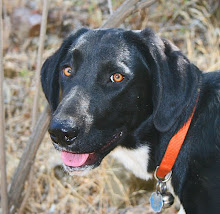
Gnawing an old coyote skull was one of Fred's happier moments at Chimineas last month.

The rest of the time he attracted deer flies from far and wide.

These particular flies were small with a banded abdomen (like many species) and they feasted on the thinly haired skin immediately behind his nose pad.


A panting short-haired black dog is a supernormal feeding stimulus for biting flies, which are attracted to carbon dioxide and infra-red radiation.

In fact, one of the more effective biting fly traps is a beach ball spray painted black suspended under a funnel that leads to a jar.

Fred was every bit as effective as an attractant, and for a fellow who usually seems impervious to pain he clearly didn't like the flies.

Pawing his nose and scraping a hole to lie in didn't protect him.

They supped well, and by the time we got home Fred's nose had a thin scab the size of a dime.

Thursday, July 1, 2010

At last a tawny cat


"You can't roller skate in a buffalo herd", and it's hard as hell to camera trap in a herd of cows.

But somehow we pulled it off.

Yes, we added mountain lion to our mammal survey of Chimineas.

It had remained on the "elusive and suspected species list" for a full year.

The dry wash we selected for set 245 didn't look particularly promising, but you never know.

We were also under the mistaken impression that there were not cattle on this particular range.


We were wrong.


Cows were coming and going day and night, and almost daily they took the liberty of adjusting the camera's perspective.


Cattle were in three quarters of the 95 photos.


But miraculously they bumped the camera back into its original position 2 and half hours before the cat strolled up the arroyo.

Wednesday, June 23, 2010

A quick trip to Sierra County

Sierra Buttes, not far from the camera traps


I made a quick trip this week to San Francisco State University's Sierra Nevada Field Campus, and knew I was almost there when Sierra Buttes popped into view.

Purpose? . . . to set camera traps for the upcoming workshop.

Left at 6:15, sans Fred (no dogs allowed at the field campus) and arrived at the field station at 9:00.

The ride had its distractions -- like the profusion of bush monkey flower in the Feather River Canyon.

Near Graeagle I stopped to photograph a field of lupine, and the perfume almost moved me to poetry.

At destination I barged into the alder thickets looking for Aplodon.

A demographic event has reduced the once thriving colony to a ghost town with one active burrow.


I set a cam at the single burrow and made two additional sets in the area.

Next I scouted logging roads for additional sites, but snow blocked my old Honda.

Then up to Yuba Pass where I pondered my next move over a sandwich -- decided to head for Deadman scree.

The problem was the Yuba River.

This codger wasn't up to rock hopping, long jumping, or pole vaulting the white water to reach the other side.


I drove back and forth looking for fallen logs, and found one that was safe to cross. It led to a boggy flood plain and an obstacle course of windblown limbs and fallen logs.

I set two more cameras with bear guards, one on a creek I had worked last year -- or so I thought.

Then I struck out for the home of pikas and bushy-tailed woodrats -- that vast expanse of scree that glares through the trees on Rt 49.

Having studied the quad the night before, I was relatively sure of my position.

Stumbling upon ancient patches of talus in the old red fir forest reinforced my confidence that I was on the right track.

The scree was southwest of me.

I had to be getting closer, but the expected opening in the trees didn't appear.

Unfortunately, talus slopes aren't shown on my GPS's topo map, and after crossing several drainages I realized that the various creeks flowing from the vicinity of Deadman Lake all look alike.

The scree was in the other direction.

I decided to cut my losses high on the slope and set the sixth cam.

It was close to 4:00.


I looped back and headed downhill until the slope became a bit treacherous.

But there was a shortcut --  a very large red fir that had fallen steeply across the Yuba.

I crossed it in slow motion, tippy-toed through a campsite, and found my car a a half mile up the road.

Mission accomplished.

Six cams are set for the workshop.


Saturday, June 19, 2010

The Mr Smiley Orthoptera Refuge


Fire season is just around the corner and you will be heartened to know that I weed whacked today like there was no tomorrow.

I felt a pang of guilt however as various katydid and grasshopper nymphs shot out of the botanical flak. 

I knew my old friend Dave Rentz of BunyipCo, aka Mr Smiley, would not approve. 

Never mind that his brother John is a retired fire chief. 

Dave has had a lifelong love affair with orthops -- grasshoppers, crickets, katydids, and yes, even cockroaches.  

When the non-biologist sees an entomologist doing his or her thing you often hear the comment  "Now I've seen it all." 

Others may approach cautiously and ask "what are you doing?" 

Mr Smiley's response was an utterance -- "Glasss-hoppah!" given with the crazed look of a character from "One Flew over the Cuckoo's Nest".

You have to admire someone like that. 

So I designed the Mr Smiley Orthoptera Reserve, and felt a little better about my carnage.


Sunday, June 13, 2010

High water in Yosemite


Nevada Fall, June 2010

The Merced River was in spate this year.  Really in spate. 

It was unusually balmy as we drove down the central valley to Yosemite last week, and the warm air drifted up the Pacific slope and kicked off a serious snowmelt. 

For the first time in 6 years we were not booked for riverside sites in the Housekeeping Camp, but when we saw the vacant flooded campsites no one in the group complained about being far from the river.

Since you needed waders to get around down there, the park rangers relocated the riverside campers to unoccupied sites, which bumped other folks who had reservations. 

There were not as many happy campers this year, and the park maintenance crew were busy removing log jams from the bridges.   


Below the bridge to the Mist trail and Vernal Fall. 


All the same, the river was a thrilling sight, and we hiked to Nevada Fall past roaring cataracks and flooded banks.


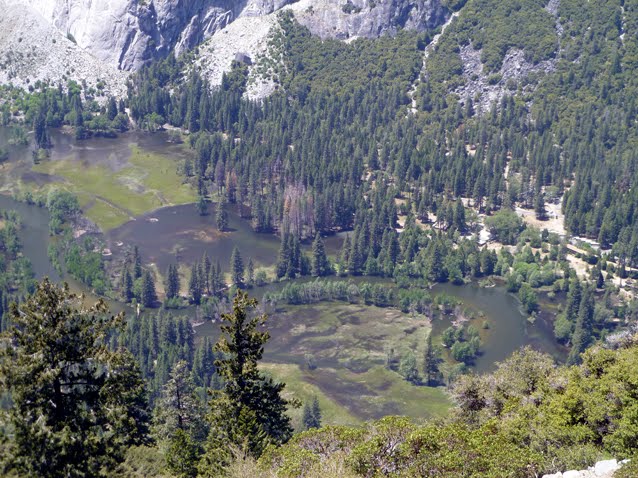
Just before it spills over Nevada Fall the river had spread over an area that was twice its width in June of previous years.


Here's the big water as seen from the Four-mile Trail to Glacier Point.

The river and falls roar around the clock, but it's best heard at night.

I don't know why, maybe it's the wind, but sometimes it sounds like breakers on a beach.

Wednesday, June 9, 2010

Badger in the mist


There was nothing new to show from the last camera trapping event at Chimineas.

Just a badger in the mist, though the mist was in the camera. (It looks like a youngster from last year's crop).

A kangaroo rat was busy in most of the frames.


And a curious steer showed up a few days before we collected the two cameras.


We're expecting some next species later this month because we made 12 sets in new and underrepresented habitats.