About Me

My photo
Native Californian, biologist, wildlife conservation consultant, retired Smithsonian scientist, father of two daughters, grandfather of four. INTJ. Believes nature is infinitely more interesting than shopping malls. Born 100 years too late.
Showing posts with label Point Reyes National Seashore Park. Show all posts

Thursday, January 17, 2008

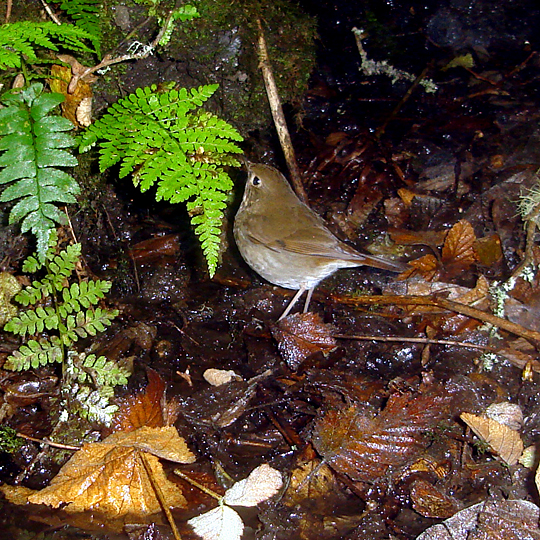
Point Reyes wren


Not the best pictures, but only half of camera trapping is about taking pictures.

Anyway, this is the kind of picture we would encounter while taking a lab quiz in Natural History of the Vertebrates back in the 60s. You had to know the key characters, of which perhaps one or two were visible.

These two images from Point Reyes National Seashore seem to be of a winter wren. The diagnostic features -- the faint eyebrow and the dark barred flanks give it away. And by the way, I had to check Sibley's guide to give you that information.

Friday, December 14, 2007

California's possum diaspora


The Virginia opossum was one of my last camera trap visitors at Point Reyes National Seashore. As reported in my last possum post, this curious possum was also attracted to the electronic flash and gazed inscrutably at modern technology.

The Virginia opossum is one of California's recent mammalian immigrants, but the history of its colonization raises many questions.

What we know is that California's ancestral possums came from MacDonald County, Missouri and Jackson County, Tennessee, and probably other places as well, though no one knows for sure.

Those pioneer possums were tough. It would have been a grueling cage-rattling trip on the transcontinental railroad, but they could have toughed it out during the warm months. Sea travel would have taken more time, and seems less likely, but their sprawling "sea-legs" would have served them well.

At the turn of the last century the Golden State had much to offer its citizens in the way of wildlife, including grizzly bears, but her settlers from the South missed their possums. Possums may not be challenging quarry for the hunter, but memories of baked possum and sweet taters summoned mouthwatering cravings.

Early Californians kept penned possums for food, but they didn't keep them for long. I suspect the possum farmers soon grew tired of their chores, and decided it would be a lot easier to harvest wild possums. Maybe that's why one W.D. Watkins set five Missouri animals free about 3 miles south of San Jose. That was back in 1900. We don't know if they survived, but if they did, rest assured they went forth and procreated. In 1910 several more possums are said to have escaped from a San Jose jeweler and possum fancier. His seven possums came from Tennesee. Apparently possum owners in Los Angeles also had a hard time keeping their stock penned.

By 1913 one hundred opossums had been captured in the greater San Jose area (Santa Clara County), and by 1915 they had apparently made their way over the coast range into the San Lorenzo Valley in Santa Cruz county. This route would have led venturesome possums to the coast, and to easy routes north and south.

An attempt to introduce possums to mountainous Shasta county failed around 1932, but possums from San Jose spread into the San Joaquin Valley, circumnavigated San Francisco Bay, and thence colonized the northern coast range, the Sacramento Valley, and the northern foothills of the Sierra Nevada.

You are looking at a descendent of those hardy pioneer possums. The foggy windswept coastal scrub of Point Reyes is a far cry from the bottomlands of the south, but like the rest of us here, Br'er possum is quite at home.


References

Gardner, A.L. and M.E. Sunquist. 2003. Opossum, Didelphis virginiana. Pp 3-29 in Wild mammals of North America (G.A. Feldhamer, B.C. Thompson, and J.A. Chapman, eds.). The Johns Hopkins University Press, Baltimore.

Grinnell, J., J. Dixon, and J. Linsdale. 1937. Fur-bearing Mammals of California. University of California Press, Berkeley.

Ingles, L.G. 1954. mammals of California and its coastal waters. Stanford University Press, Stanford, California.

Lidicker, W.Z., Jr. 1991. Introduced mammals in California. Pp 263-271 in Biogeography of Mediterranean Invasions. (R.F. Groves and F. di Castri, eds.) Cambridge University Press, Cambridge, UK

http://www.geocities.com/royvandehoek/virginiaopossumanthology.htm

Sunday, December 2, 2007

Red Sally, the cold blooded night stalker


October 25, 7:27PM: We are back at Point Reyes National Seashore again, where a cold blooded night stalker padded past the camera looking for edible victims in the leaf litter.

This record of an Eschscholtz salamander (Ensatina eschscholtzii) was a stroke of good fortune. The camera's passive infrared (PIR) sensor does NOT respond to cold moving bodies. A warm moving body -- brush rabbit, deer mouse, or wood rat -- must have triggered the camera just before the salamander moved out of the frame. Whoever it was, I am grateful.

Ensatina, a salamander without lungs . . . I remember it well from collecting forays on the San Francisco peninsula. Its fruity (ripe persimmon) complexion, laterally compressed tail, and constricted tailbase give it away as the yellow-eyed subspecies xantoptica -- commonly called the red salamander.

Red Sally's fiery coloration reminds some predators of bad dining experiences. It is believed to trick birds by looking like a newt. It is a mimic of newts. We have three species of newts here, and all of them have skin laced with tetradotoxin, the same stuff that makes pufferfish deadly poisonous. Birds that have gagged on toxic newts are tricked by Red Sally the imitator. But the salamander probably doesn't fool snakes, that have limited color vision, but a powerful Jacobson's organ.

Red Sally chooses a subterranean existence until the fall rains. Ninety-four years ago and not far from here the California naturalist C.L. Camp found a red salamander nest 2 feet deep in a mountain beaver burrow. Why not? Coastal scrub offers little in the way of ground cover and fallen logs, but mountain beaver burrows and woodrat nests offer a stable microclimate and plenty of insects, though they don't guarantee freedom from predators.

Stebbins notes that "When the surface is damp and temperatures not too high, considerable time is spent above ground where most feeding probably occurs." That's probably what Red Sally was doing here.


References

Stebbins, R.C. 1951. Amphibians of Western North America. Berkeley and Los Angeles.

http://www.santarosa.edu/lifesciences2/ensatina2.htm

Friday, November 30, 2007

Clapper rail


We decided to shoot down the Sacramento valley this week and stop at Point Reyes National Seashore to gather the three camera traps. My permit to camera trap there expires in January, and the redhead, who happens to be the spirit of Christmas in this family, suggested we do it now before things get too hectic.

Before heading down into the gulch, I vowed to pull the cams without pausing to view the pics.

Normally the redhead watches me with binoculars from the road, and radios the whereabouts of elk. This has attracted park visitors who ask, "Any good birds today?" or "Have you seen any elk?" Usually she signals me as they approach, and I duck out of sight like a commando.


There was only one lone bull elk in the area, and when it disappeared into the next gulch, she informed me she was retiring to the car to read.

Finding the first camera was a workout. The GPS told me I was on top of it, but it took me 15 minutes to find it 6 feet away on the other side of the thicket. It took more time to pussy-foot my way to the other camera sets, because the rains have turned the bottom of the gulch into a quagmire, and the elk have churned it up like water buffalo in a rice padi. It took a full hour and a half to collect the cams and posts.

After dinner I downloaded the pictures, and the big surprise was the clapper rail. This is actually the California clapper rail, an endangered subspecies from the San Franciso bay area.

The bird visited this muddy drainage site a week ago at 4:10 in the afternoon. This was a new camera trap set I made during my last visit over 6 weeks ago, and it was also my final desperate attempt to get more pictures of mountain beavers. (The wiley rodents seemed to have disappeared from their haunts where I photographed them back in July. More about them in a few days.)

The location is a waterlogged thicket at the base of a steep hill. I don't think this is the kind of place a birder would look for rails. Nearby in Abbott's lagoon and the backwaters of Drake's Estero there is more typical marshy habitat, but there is plenty of cover here, and the soil is deep and wet.

The only other avian visitor was a hermit thrush.


Rails feed mainly on invertebrates they probe from the mud, but small vertebrates like this shrew are said to be fair game. (See the velvety gray hair and bicolored tail -- it's another Sorex trowbridgeii.)


These were lucky pictures, because the camera is set for night time shots. Dim overcast lighting and shade had fooled the camera into thinking it was night. In five months of camera trapping this gulch, this is the only rail captured by the cameras. I am pleased.

Thursday, October 4, 2007

A very small mammal


We spent a few days in San Francisco this week before visiting the camera traps at Point Reyes National Seashore.

I touched base with my old friend Ray Bandar, aka Mr. Bones, a reliable and colorful source of bay area natural history.

Ray said there are no new reports of coyotes in Golden Gate Park, but a ripe young gray whale carcass had beached south of the city and made the evening news. High tides have been scouring the beaches, so the marine mammal veterinarians moored the carcass with a rope the day before the necropsy. After they left, someone, or perhaps a group cut it loose and performed a memorial service for the deceased whale. Only in San Francisco. Then the vets did the needful, and found that the organs were in a semi-liquid state. Not long after they finished a high tide swept the scattered and stinking mess back into the sea.

Okay. Yesterday morning we headed across the Golden Gate for Point Reyes National Seashore. The weather was excellent in the bay area, but there were high winds up on Tomales Point. Rutting tule elk are one of Point Reyes's attractions these days. The elk are in hard antler, but as far as I can tell, the hard rut hasn't yet begun. The bulls seem rather laid back, and I didn't hear a single bugle call in two hours. One couple took their pictures standing beside a park service sign warning visitors that the rutting elk are dangerous: "do not approach".

My camera trapping area is a favorite loafing area for the elk, and the picture above is actually one of their trails. A month ago I set one camera nearby at an elk wallow, and the next morning a young bull thrashed it with his antlers. When I found the camera two weeks later it was intact but buried in muddy vegetation. I reassigned it to mountain beaver duty.

Down into the tangled thicket to change batteries and memory sticks. Even with a GPS it takes more time to find cameras there than you'd expect. I sat in the brush and scoped 2-weeks of pictures in each of the 3 cameras.

Drat! There was no image that faintly resembled a mountain beaver, so I moved two of the cameras to wetter areas. Then a dense fog rolled in and I backtracked to the road using the GPS.

Next day (home again).

Surprise! I just viewed the pictures on the computer, and was pleased to find a very small mammal in three pictures. I couldn't see it in the LCD yesterday. It was a shrew, the mightiest of the mini-mammalian predators! (gleeful chuckling in the background).

They were taken over a period of 18 seconds (8:53PM, August 30). You can just make out the shrew in the uncropped photo above, but I've cropped them for a better view below.

It could be any of three species (Sorex trowbridgei, S. vagrans, or S. pacificus). I am guessing it's a Trowbridge shrew. It looks large, and the tail looks bicolored.


Plus, the tail seems almost as long as head and body.


And do you see that faint line across the back? That, I would bet a bott'l o' Guinness--is a molt line.

If any of you mammalogists have an opinion about the identity of this shrew, feel free to send me a comment.

[Note: There'll be at least one more post from this outing, and then I'll be talking about animal espionage agents, and a crow that practiced proctology. Stay tuned.]

Monday, July 30, 2007

Hark, the Mountain Beaver


Hark to the mountain beaver, one of California's most mysterious and best kept secrets. It's not a beaver, and it doesn't live exclusively in the mountains. So . . . you may want to call it by its other name --boomer. Not that that is any better, because they don't "go boom" either.


We should take pride in this lovely, furry muskrat-sized rodent with a stub-tail. It's a living fossil and a unique American mammal. Aplodontia rufa is the only member of its family, the Aplodontiidae. Its ancestral relatives were digging up the Great Plains back in the Late Oligocene and Miocene, and were related to the Mylagaulids, which were more diverse and included the horned gopher -- Ceratogaulus of the Great Plains. That makes the mountain beaver a sole survivor of a once diverse assemblage of rodents.

Until a few weeks ago I knew the species only from the plush furs of museum specimens and the literature. But I always wanted to know the animals in the flesh, so to speak. My chance came this spring when the National Park Service approved my application to do a camera trap survey of wildlife in Point Reyes National Seashore.


The coastal scrub of California seems an unlikely place for mountain beavers. They live in lush conifer-shaded creekside habitats in most of their range, and usually on steep slopes. In addition to the main populations in the Sierra Nevadas and Cascades, California has two small isolated populations at Point Reyes (285 sq. km.) and Point Arena (62 sq. km.). These are in the fog belt of the north coast.

These island populations were obviously connected at some point in the past. As recently as about 3,000 years ago, mountain beavers lived betweeen these two sites. Gnawed bones from Duncan's Point Cave tell us that carnivores were catching them there near the mouth of the Russian River.

During a state-wide distributional survey of mountain beavers, biologist Dale Steele also discovered an even more unlikely habitat in the alkali scrub of Mono Lake. This truly looks like a no-mans-land for mountain beavers, because water limits its distribution. Unlike other rodents, mountain beavers are unable to produce a concentrated urine by resorbing water, because their kidneys lack the loops of Henle which perform this function. They need plenty of free water and succulent vegetation to survive.

Nonetheless, there they are at Mono Lake, pocketed in an oasis with a questionable future. I don't think it is known whether these particular mountain beavers are brave recent colonizers, or old stragglers from earlier and wetter times.

The coastal scrub at Point Reyes on the other hand is sodden during the winter and spring, and fog-bathed in summer and fall. The coastal scrub forms impenetrable thickets of coyote bush, blackberry, Euonymous, poison oak, cow parsnip, and thistle (among others). Here and there deer and elk have blazed trails through the stuff, which brings coyotes and bobcats a little closer to the mountain beavers' inner sanctum. But I got a clear impression that only smaller predators like weasels, skunks, and perhaps gray foxes can penetrate the tangles to the heart of boomerland.

When wildfire burned 5000 acres of Point Reyes's habitat in 1995 wildlife biologist Gary Fellers and co-workers discovered that mountain beavers were more abundant than previously estimated. With home ranges no larger than a half acre and a fairly tolerant disposition, quite a few can pack into an area, but for the most part they are hidden in the thickets.

During 27 camera trap days, the cameras made 858 exposures of which 31% contained animal images. Of the 8 species photographed, mountain beavers were in only 7% of the photos, and most of them looked like this.


I am not satisfied. I want a full-body shot worthy of a centerfold. Clearly I need more time to catch the boomer disporting itself out of its burrow.


Acknowledgement:
Many thanks for the cooperation of Point Reyes National Seashore, National Park Service. I am grateful for the assistance of Drs Ben Becker (NPS) and Gary Fellers (USGS).

References:
Beier, P. 1989. Use of habitat by mountain beaver in the Sierra Nevada. Journal of Wildlife Management, 53(3):649-54.

Carraway, L.N. and B.J. Verts. 1993. Aplodontia rufa. Mammalian Species, No. 421, 1-10.

Fellers, G.M, D. Pratt, and J.L. Griffin. 2004. Fire effects on the Point Reyes Mountain Beaver at Point Reyes National Seashore, California. Journal of Wildlife Management, 68:503-508.

Martin, P. 1971. Movements and activities of the mountain beaver (Aplodontia rufa). Journal of Mammalogy 52(

Steele, D. T. 1974. An ecological survey of endemic mountain beavers (Aplodontia rufa) in California (1973-83). State of California, The Resources Agency, Department of Fish and Game. 51 pp. (pdf)

Steele, Dale. Mountain Beaver (Aplodontia rufa) Journal

Wake, T.A. 2006. Archaeological sewellel (Aplodontia rufa) remains from Duncan's Point Cave, Sonoma County, California. Journal of Mammalogy 87(1):139-147.