For those of you who don't recall "The smell of dead meat", here's another story on the theme.
It's about what can happen when (a) a cougar (the four-legged variety) crawls under your deck and dies, (b) your guests notice the smell over a glass of wine, and (c) you discover that you are anosmic.
Talk about good luck -- how many folks can brag about a cougar dying under the deck?
About Me
- Camera Trap Codger
- Native Californian, biologist, wildlife conservation consultant, retired Smithsonian scientist, father of two daughters, grandfather of four. INTJ. Believes nature is infinitely more interesting than shopping malls. Born 100 years too late.
Saturday, April 16, 2011


Friday, April 15, 2011
Camera U's final gift

For the camera trapper who has forgotten that creeks flood and that dirt roads can turn into quagmires, or believes that engineered wetlands maintain a constant water level, or thinks he walks under a lucky star . . . well folks, this is what can happen.
Welcome to the Sacramento Valley in December -- December 2, to be exact.
That's when the story began, when yours truly and Random Truth staked Camera U at the edge of a riparian wetland.
I had great expectations. The place was crawling with wildlife.
And sure enough, otters and raccoons left 12 images the very first night.

That's right, river otters -- my first camera-trapped otters on the first night!
The place was hot.

During the next four days Cam U snapped another 19 images.
The raccoons kept coming, and there was the tail-end of an egret and black-tailed deer.

On December 6 the water started to rise, and the promise of set 444 faded rapidly.

In three minutes the water level rose another 4 inches, and at 45 minutes past noon Cam U went under.
Under water it shorted and snapped 50 blurry photos in 3 minutes.

And that was it.
Camera U was finito.
A couple days ago I removed the precious memory stick and cleaned the sludge from the contacts.
It still worked, and that's why there is more to this story than the two photos at the beginning and end.
At the moment Camera U is lying in state on my work bench.
When dry it will join other casualties in the camera trap catacombs, which is just a box in the closet.

Tuesday, April 12, 2011
Rainy day ringtail

It was raining after the clock struck one on March 6th.
That's when the ringtail came grubbing around the base of the outcrop.

In three and half minutes the camera snapped it only three times.

This location is about three quarters of a mile from the previous ringtail set, but with a home range as large of 1500 acres this ringtail could be the same animal -- though I doubt it.
It's going to take some work to get a decent portrait of this critter, but I'd settle for a mediocre picture of mother ringtail and the kids.
Soon the kids will be in tow, hopping about, exploring, and playing.
Sunday, April 10, 2011
The Yesin observed
 |
| Sketch of a yesin balanced on a tumbler |
[Continued from "The elusive Yesin"]
"Is there such a thing as a 'Yesin' or not? "
That was how Colonel Hla Aung, Director of the Rangoon Zoo launched his dissertation on the cryptic mini-beast in the Sunday Working People's Daily of Rangoon on August 30, 1970.
A lot had happened since Hopwood sent the fake yesin to Bombay for indentification.
The Japanese invaded Burma weeks after Pearl Harbor, thousands fled through the Naga Hills to safety in India and thousands died along the way.
Claire Chennault, the Flying Tigers, General Slim, Vinegar Joe Stilwell -- they all came and went, and 4 years after the war ended Burma won independence.
Rumors of the yesin hadn't gone away, and Hla Aung did a service to crytozoologists by summarizing reports in obscure periodicals (though I should note that you won't find the Working People's Daily on the internet).
The yesin apparently was not an uncommon subject in the news at the time, but the reports and photos were usually about the talismanic dried remains in the possession of elephant oozies or mahouts.
Burmese dacoits and mahouts shared in their belief in the power of protective talismans.
Dacoits trusted that carved talismans in the image of spiritual nats conferred invincibility against bullets.
Like so many cloves of garlic the talismans were inserted into cuts in the skin and bolstered the bandits' confidence to undertake remarkable feats of daring.
Once captured by the colonial police however, the dacoits' truculence was easily undone when the talismans were extracted with razor blade.
Similarly, mahouts believed that a dried yesin or its tusk was a magical goad capable of making a bad elephant good or spurring a lazy timber elephant to obedience.
When U Ba Myaing published his yezin investigations Hla Aung summarized the results.
U Ba Myaing was a retired Veterinary Inspector of the colonial government stationed in Sandoway, now Rakhine State.
He started interviewing coastal fishermen in 1925, but ten years passed before he managed to lay hands on male and female specimens caught by fishermen.
He gave a meticulous description.
The skin was gray and smooth (no mention of hair), and the stomach, which was apparently single chambered and the size of a gooseberry, contained plant matter and algae.
It was 6 inches long, and the tusks in this animal grew from the upper jaw (unlike the faked yesin jaws made from rodent mandibles).
Col Hla Aung also wrote of his own experiment to test the alleged fear of yesin shown by zoo elephants.
The elephants showed no reaction to sniffing a box containing a dried yesin.
He concluded his article,
"Although only faked specimens of the 'Yesin' had come to light so far, there is every reason to believe from the evidence collected by field observers, that a real 'Yesin' belonging to a separate genus of mammal does exist, and when fresh specimens of a "Yesin' are obtained in the future, it will be possible to verify the true nature of the animal."
The question is this: is the yesin an undescribed species of water rat?
[N.B.: coming soon -- a modern yesin hunter].
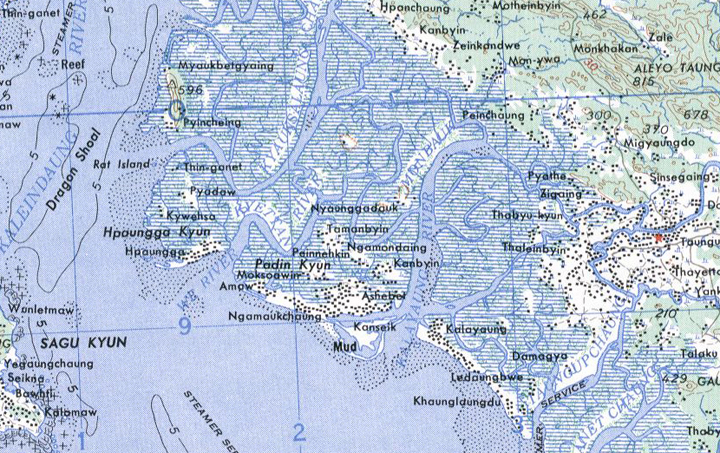 |
| The female yesin was captured in Ngamaukchaung, an estuarine creek on Padin Kyun (kyun = island) |
The skin was gray and smooth (no mention of hair), and the stomach, which was apparently single chambered and the size of a gooseberry, contained plant matter and algae.
There were 4 toes on the front and hind feet, the tusks were 1.5 inches long, and the reproductive organs were elephant-like. The male had a quarter inch long penis.
The inspector was well aware of the elephant's alleged fear of the yesin and the belief of elephant men that a dried yesin, mini-tusk, or even a scrap of skin could be used to control even the most recalcitrant man killer.
He reported his experiment of hiding a yesin tusk in a stream -- it struck such fear into several working elephants that their mahouts were unable to drive them into the water.
In another instance, the prxomity of the yesin caused a cow to abort its fetus.
Then there is the report of Thakin Khin Maung Oo (aka Bo Taya) of Thirty Comrades fame, who saw a pair of yesin disporting themselves in a rocky pool in the Pegu Range near the Shan Plateau.
He organized the mahouts to trap one using a bamboo fish trap, and kept the captive in a kerosene can filled with water.
When it died three days later he measured and dissected it.
In another instance, the prxomity of the yesin caused a cow to abort its fetus.
Then there is the report of Thakin Khin Maung Oo (aka Bo Taya) of Thirty Comrades fame, who saw a pair of yesin disporting themselves in a rocky pool in the Pegu Range near the Shan Plateau.
He organized the mahouts to trap one using a bamboo fish trap, and kept the captive in a kerosene can filled with water.
When it died three days later he measured and dissected it.
It was 6 inches long, and the tusks in this animal grew from the upper jaw (unlike the faked yesin jaws made from rodent mandibles).
Col Hla Aung also wrote of his own experiment to test the alleged fear of yesin shown by zoo elephants.
The elephants showed no reaction to sniffing a box containing a dried yesin.
He concluded his article,
"Although only faked specimens of the 'Yesin' had come to light so far, there is every reason to believe from the evidence collected by field observers, that a real 'Yesin' belonging to a separate genus of mammal does exist, and when fresh specimens of a "Yesin' are obtained in the future, it will be possible to verify the true nature of the animal."
The question is this: is the yesin an undescribed species of water rat?
[N.B.: coming soon -- a modern yesin hunter].
References
Evans, G.H. 1910. Elephants and their diseases. A treatise on elephants. Rangoon, Superintendent, Government Printing, Burma.
Hla Aung, Col. 1970. The water elephant or Yesin. The Sunday Working People's Daily, August 30, 1970.
U Ba Myaing. 1970. 'Yesin'. Loketha Pyithu Nezin, August 13, 1970 (not seen, reference mentioned in Hla Aung's article.)
Thursday, April 7, 2011
Elephant offs cam

"Here are the photos of naughty elephant. Destroyed a trap-camera."
That was UMA's terse message received last night with photo attachements from the Rakhine Yoma.
The trainees from the camera trapping course just completed their first elephant survey.
The elephant appears to be a young adult makna (pronounced muck-na) or tuskless male.
He almost walked past the cam, but must have seen the infrared flash, which isn't a flash at all -- just a dim and momentary red light.
I'm assuming that's what caught its attention.

He did a double take and reached out to the camera.


I'm assuming that's what caught its attention.
He did a double take and reached out to the camera.
The infrared flash doesn't freeze action, thus the blurry image.
He started to move on, but changed his mind.
And the last clear photo was up close and personal. After that he "offed" the camera.
UMA confided that our jungle man, Ye Myint had staked the camera to a sapling.
That's a "no-no", especially in elephant country.
Lesson learned.
When in elephant county lash your camera to "a beeeg tree" and make sure the spiked camera protector is clamped on tight.
Tuesday, April 5, 2011
Camera trapping can be emotional
Camera trappers soon learn the agony of defeat, but sooner or later they celebrate the thrill of victory.
It can be a heady experience, as you will see in this footage when famous wildlife photographer Gordon Buchanan views his camera trap results in the field in Bhutan.
It can be a heady experience, as you will see in this footage when famous wildlife photographer Gordon Buchanan views his camera trap results in the field in Bhutan.
Sunday, April 3, 2011
Defiance in black and white
 |
| Nov 17, 2010, 6:12PM |
If not trigger happy skunks certainly are quick on the draw.
The majority of my countless skunk photos are of peaceful citizens mindlessly ambling about in the darkness while sniffing and scratching for grubs.
Occasionally however they notice the camera trap's lens movement.
Then they raise the white flag of warning.
That's as far as it goes.
It usually takes a clear and present danger to set off a skunk, and as far as I know no skunk has found a camera trap sufficiently threatening to drop the bomb.
Gun fighters shouldn't waste ammo.
I didn't give much thought to the portrait of the defiant Stinkerella below -- the handstand, hind feet ajar, and all that -- I'd seen it before,
 |
| Dec 30, 12:30 AM |
but then I saw Randon Truth's excellent photo of another hand-standing Stinkerella.
Its warning flag was fully flared. My Stinkerella's tail was as tight as a shaving brush.
The difference made me wonder.
Was it just a chance difference, or is there more to it than that?
Can you predict the spotted skunk's readiness to cut loose by the flare of the hair of its tail?
Does the spotted skunk furl its flag before dropping the bomb?
Why not? Wouldn't pissing your tail be like shooting yourself in the foot?
I decided to ask my colleague Galen Rathbun, who once had a pet spotted skunk about the tail business.
Its warning flag was fully flared. My Stinkerella's tail was as tight as a shaving brush.
The difference made me wonder.
Was it just a chance difference, or is there more to it than that?
Can you predict the spotted skunk's readiness to cut loose by the flare of the hair of its tail?
Does the spotted skunk furl its flag before dropping the bomb?
Why not? Wouldn't pissing your tail be like shooting yourself in the foot?
I decided to ask my colleague Galen Rathbun, who once had a pet spotted skunk about the tail business.
Here's what he said . . .
"I had a Spilogale and kept it in a large rabbit hutch behind the house.
I could take it out but since it wasn't de-scented I never took it into the house.
My mom was very tolerant of my various and numerous critters, but she wasn't that tolerant.
I was going to College of San Mateo at the time, on the old Coyote Point campus, and on several occasions I put the skunk in the cab of my Chevy pickup for the drive from Woodside to Coyote Point.
It was in its nest box, but was able to run about in the cab while I was in class.
It only happened once.
It let loose in the truck while I was in class.
I don't know why it happened, but suspect some student saw the skunk and harrassed it from outside.
Anyway, I had to drive my pickup with all the windows open for quite a while.
If this had happened in the house, I might have become homeless when such a lifestyle was pretty rare."
So Stinkerella's furled flag of defiance remains a mystery.
And if any of you are wondering why anyone in their right mind would take an intact skunk to school in their pickup truck, well, you just haven't known many zoologists.
Subscribe to:
Comments (Atom)